Blog
NR Times Award-winner Gary Dawson on turning tragedy into purpose
NR Times Award-winner Gary Dawson on turning tragedy into purpose
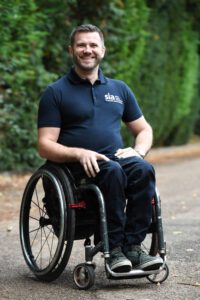
Gary Dawson is Support Network Manager at the Spinal Injuries Association (SIA). Gary’s incredible peer support and fundraising efforts won him the Inspirational Contribution award at the 2025 NR Times Awards.
We sat down with Gary to reflect on his remarkable journey from a life-changing motorcycle accident at age 19 to becoming an inspiration for others living with spinal cord injuries.
Hi Gary. Can you take us back to before your accident? What was life like for you then?
I was like any other typical 19-year-old lad: confident, thought I knew my place in the world. I loved my job as an electrician. I’d been Apprentice of the Year two years running. I was riding my sports bike, going to the gym every day, going out at weekends, just really embracing life. And then, everything changed.
What happened on the day of the accident?
We’d had about three or four weeks of blistering sunshine and then on the morning I set off, we had a flash flood. I waited for the rain to pass, and when the sunshine came back out, the roads were just like ice. As I went around a one-way system heading back into Manchester, I could feel the grip on the road wasn’t great. As I was slowing and gearing down, the back wheel just lost grip. When it snapped back into place, it caused a highside. I was launched off the bike, went ragdolling down the road, hit the back of a car, and then my own bike followed me down and crushed me into the car.
Can you take us through your recovery in the hospital?
Ten days after my injury, I sustained a massive pulmonary embolism. My family was sent in to say goodbye and were told that I’d be dead in 15 minutes.
The hospital pumped me full of an experimental drug and I spent about seven to 10 days in a coma. My family were then told I was going to be braindead.
When I actually woke up in intensive care, I was completely paralysed from the chest down with complete muscle atrophy in my upper limbs and couldn’t speak because I was tracheotomised. But I was alive. They really emphasised how amazing that was, because I just shouldn’t have survived. The part of me that wasn’t paralysed recovered incredibly quickly. From injury to transferring over to spinal rehab was around two months. Then I was only in spinal rehab for seven weeks, whereas back then the average time would have been six to 12 months. I just got really stuck into rehab and embraced this wheelchair they gave me, which gave my independence back.
What helped you get through the mental side of your recovery?
Going home is the only thing rehab doesn’t prepare you for. It’s very practical: ‘here’s a skill, this will enable you to transfer, dress, get out of a car.’ But while you’re in the spinal unit, you’re so protected by this NHS bubble. You have every healthcare professional on hand, but most importantly, you have 40 other people with spinal cord injuries all going through it together. When I went home, I suddenly realised my peers were gone. My friends and family were putting me on this pedestal, saying things like, ‘you’re amazing, you’re fantastic, if it was me I could never…’ That makes it really difficult because you’re not only only trying to cope with your situation, you’re also having to live up to everyone else’s expectations. As a young man in the early 2000s, I buried it all inside. This was a time when ‘men were men’ and you weren’t supposed to cry or show weakness. Instead of dealing with my emotions, I turned to drink, drugs and self-harming. I attempted to take my life several times. But nobody knew.
What changed things for you?
The first thing that saved me was the support of my grandad. He took me down to my local wheelchair basketball club and kind of forced me to go in. As soon as the guys saw me, they were like, ‘let’s get you in a chair.’ That changed everything for me. It not only got me fit and strong and gave me purpose again, but I had access to people who were living with disabilities. I could tap into their lives – they were married, going on holidays, working. That was just incredible. The other thing was getting my driving license. When I was struggling at home, surrounded by this new world that just screamed ‘you’re disabled,’ I was able to get in a car and just go to Tesco at two in the morning and chat to the staff. I’ve often said 24-hour shopping really saved my life because I had access to the world. I could take control of my independence. I was no longer reliant on my grandparents taking me to every appointment – it was now on me. That responsibility really put me on the right pathway to rebuilding my life.
How did you come to work with the SIA?
I rehabbed with a chap called Steve Rimmer who started working for the Spinal Injuries Association. I’d gone backpacking around Australia with my brother, been to Kuala Lumpur and Malaysia. I posted on Facebook, and Steve saw it and asked if I wanted to come into the spinal unit and talk to patients about life after injury. I was like, ‘absolutely’. I knew how hard it was to live with this notion that everything is gone. If I could inspire someone and show them that traveling or doing something adventurous is possible, then absolutely. I started volunteering for the SIA in 2008 and I loved it. The more I did it, the better I got at finding the right areas to talk about. I was able to offer insights into the more taboo side of spinal cord injury – bowels, bladder, sex, relationships, the feeling of impending doom. No one wants to talk about those things, but I was comfortable discussing them in a way that was hopefully positive and not scary.
I volunteered for years until I got the opportunity to apply for the role of Local Peer Support Officer covering the Northwest. I’d told the previous officer who moved to a different role at SIA: ‘if you ever move on, please let me know because I need to apply for this job.’ I applied, and I got it.
You’ve also become known for your fundraising work, particularly the overseas cycles.
Supporting the SIA enables me to give back in a way I would never be able to otherwise. I didn’t have any compensation claim or millions sitting around. This coming May will be my 12th overseas cycle for SIA, which has not only been great for challenging and testing me, but I’ve been able to raise tens of thousands of pounds for the SIA. My family comes along too. My sister met her now-husband, with whom she has two kids, on one of the SIA overseas cycles. My family drove out to Paris to meet us at the end of the first one. They were so taken aback by this energy of the people that they signed up and have done almost every single one since. So it’s really important to me – not only from the financial aspect to raise money to support more people, but there’s a whole family I’ve gained through these cycles.
We often hear in spinal and brain injury that people become advocates by necessity. Has that been your experience?
Absolutely. Once you’ve gone through it and get to that stage mentally where you’re comfortable talking about the more challenging aspects, that does motivate others. They could be in that early part of their journey where they don’t see a positive future, or further down the line and have got into a bit of a rut. I recently got stuck on a Metrolink tram stop in Manchester because the lift broke down. I used that as an opportunity to highlight how it’s just not good enough, which went viral. There was a massive, incredible response by the local community and the lifts got fixed. Being comfortable to share that and not just hide away from it is important. I’ve been in nightclubs where I’ve heard someone make fun of me, and instead of challenging them, I went home crying because I didn’t have that confidence at the time. But one day I found my voice. I said, ‘okay, that’s really funny. I appreciate your joke, but let me tell you how that’s impacted me. Let me tell you about my life. Let’s see if it’s still as funny when you fully appreciate what I go through and how hard it was for me to come out here tonight.’ When more people do that, the bigger voice you’ve got and the louder you can shout, the more impact it has.
Original story written by Gordon Stribling for NR Times (12 February 2026)