Blog
Julie's Story (Paralysed Bowel Awareness Day 2026)
Paralysed Bowel Awareness Day 2026 – Julie’s story

Six months after Julie Wardlow (62) from Sheffield had a routine knee replacement, she started experiencing muscle spasms. Within a year, she was paralysed below the chest due to a spinal cord injury in her neck sustained during the surgery.
Six months after Julie had a knee replacement in 2017, she started having muscle spasms. She recalls, “I’d just be reading a paper or something and my hand would flicker.” After repeated visits to the GP, an MRI revealed that five of the seven vertebrae in her neck were fused, causing damage to her spinal cord. She has since been told that when she went for her knee operation, it is possible that the anaesthetist put her head back too far or too quickly, causing the vertebrae to fuse. However, this theory could never be proven and Julie is still unsure that this was the cause.
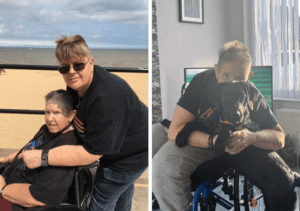
As she began to lose mobility, Julie went for an operation in the hopes of reversing the damage. She stayed in Northern General Hospital for seven weeks before moving to Princess Royal Spinal Cord Injuries Centre for a further seven months of specialist rehabilitation. After her operation, Julie used a wheelchair for the majority of the time, but could stand for transfers and walk short distances with a Zimmer frame.
Julie was hoping to regain enough movement to be able to walk again, until one day her legs became suddenly paralysed. Another MRI revealed that scar tissue had formed in her spinal column, causing permanent damage to her spinal cord.
As well as the paralysis, Julie experiences constant nerve pain, and has lost bladder and bowel function. Since her injury, she has struggled to get appropriate bowel care in general healthcare settings, both in care homes and in hospital.
Julie has been forced to spend a month in a care home for the elderly when her partner, who is also her carer, went to visit her sister in Canada. Although the care home was inappropriate for her needs, there was nowhere else available and Julie and her partner had no choice. Julie’s biggest challenge was that the staff did not understand the time-consuming nature of her bowel care routine.
They were bringing breakfast in and it was half an hour, three quarters before I got to it. They were just going through the motions and not thinking about me, so I’d have porridge or something sat there for half an hour or something like that.
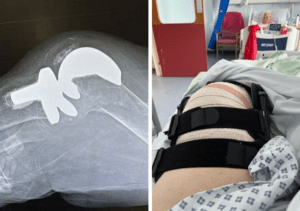
Recently, Julie fractured her leg when the front bar of her electric wheelchair collapsed and pulled her legs underneath the chair. She was taken to a general hospital where she had a rod and screws put into her thigh. She stayed there for seven weeks.
When Julie explained her bowel care needs to medical staff, she was still not given the care that she needed. After seven weeks without bowel care, Julie started to experience symptoms of autonomic dysreflexia, which she experiences as uncontrollable shivering, muscle spasms, and confusion. The condition affects people with high level spinal cord injuries and can be fatal due to extremely high blood pressure.
Julie only received the care that she needed because she got in touch with Spinal Injuries Association, who advocated to get her a bed in the spinal unit, where staff were trained to do bowel care.
I find that’s normal in general hospitals. They just don’t know about spinal cord injured people, and it’s embarrassing to tell them. People see the wheelchair and they think, well fine, your legs don’t work, but they don’t see what goes on behind the scenes.
PARALYSED BOWEL CARE AWARENESS