Blog
Lincolnshire NHS Group improve safety for patients with paralysed bowels
Lincolnshire Community Hospitals Group has joined with Spinal Injuries Association to improve patient experiences for people who have lost bowel function after injury or illness.
While no official figures on the prevalence of paralysed bowels exist, the charity estimates that over 457,000 people in the UK with neurological conditions, including spinal cord injuries, multiple sclerosis, and Parkinson’s disease, experience the symptoms of paralysed bowels, which may present as incontinence or retention. As well as being essential for patient dignity, proper bowel care is also needed for patient safety and medical wellbeing.
Last year, a collaboration of disability charities – Spinal Injuries Association, Aspire, Cauda Equina Spinal Cord Injury (CESCI), Spinal Research, Regain Sports, Stoke Mandeville Spinal Research, and spina bifida charity Shine – launched the first National Paralysed Bowel Care Awareness Day to raise awareness of the condition and to advocate for better training for NHS staff.
Lincolnshire Community Hospitals Group is one hospital trust that is working with national spinal cord injury charity Spinal Injuries Association to update their policy and train staff in paralysed bowel care. By working with specialist spinal cord injury (SCI) nurses from the charity, the trust has identified key staff to champion paralysed bowel care in the hospitals and to help improve patient experiences.
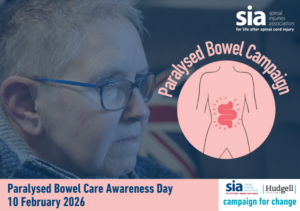
The need for such training is highlighted by Julie Wardlow (62) from Sheffield, who sustained a spinal cord injury in 2017.
As a result, Julie is paralysed from the chest down, experiences constant nerve pain, and has lost bladder and bowel function. Julie requires regular and specific care to maintain a proper bowel routine.
In 2025, Julie was sent to hospital after the front bar of her wheelchair collapsed, pulling her legs underneath and fracturing her femur. She was in hospital for seven weeks, during which time she was not given proper bowel care.Julie is at risk of autonomic dysreflexia, a condition that affects people with high level spinal cord injuries and is characterised by dangerously high blood pressure that can be fatal if not properly managed. It is frequently triggered by improper bowel care and Julie started experiencing symptoms, including uncontrollable shivering, muscle spasms, and confusion. Julie only received the care that she needed because she got in touch with Spinal Injuries Association, who advocated to get her a bed in the spinal unit, where staff were trained to do bowel care.
Julie said,
“I find that’s normal in general hospitals. They just don’t know about spinal cord injured people, and it’s embarrassing to tell them. People see the wheelchair and they think, well fine, your legs don’t work, but they don’t see what goes on behind the scenes.”
Having recognised the need to improve paralysed bowel care for patients like Julie, Lincolnshire Community Hospitals Group has been working with Spinal Injuries Association to train nursing staff and to implement a neurogenic bowel care policy.
A representative from Lincolnshire Community and Hospitals NHS Group said,
“We are always looking at ways of continuously improving our patient experiences and the success of our Bowel Management Task and Finish Group is testament to what can be achieved when we work in partnership with other specialist organisations. With cooperation and shared expertise, we have been able to improve patient outcomes through strengthening training and policy, helping to provide a better hospital experience”.
While staff across the Group are leading the way in paralysed bowel care, it remains a problem throughout the UK.
Val Milnes (76) from Houghton-le-Spring sustained a spinal cord injury in 1996 in a skiing accident.
When Val was admitted to hospital for surgery in 2022, she received no bowel care for two weeks, resulting in an impacted bowel. When she returned home, Val was forced to stay in bed for three months due to symptoms that resulted from the lack of bowel care.
“I didn’t think I was ever going to get better and I was going to be confined to bed for the foreseeable future”.
She required a further nine weeks at the spinal unit to recover, receiving physiotherapy to rebuild the strength she lost while having to stay in bed.
Spinal Injuries Association’s SCI Specialist Nurse Lead, Carol Adcock, said,
“Paralysed bowel care should not be ‘a nice to have’ in the NHS. It is an essential care requirement in both acute and community healthcare settings. Providing this care will prevent avoidable complications and costly hospital admissions. It is much cheaper, and humane, to provide structured, appropriate timely interventions than treat unmanaged paralysed bowel.”