Blog
The unstoppable Dani Czernuszka-Watts (Forward - Winter 2025)
In 2017, former rugby player Dani Czernuszka-Watts was left T10 injured after a foul tackle from an opponent. 8 years on and Dani, mum of three, is now embracing the world of para ice hockey.
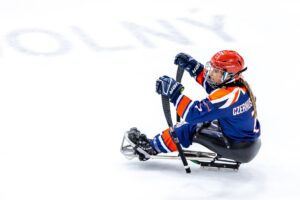
Here she talks about resilience, freedom on the ice and accepting plan B days:
Q: You’ve just been to the para ice-hocky women’s world champions – how was that?
A: It was really wholesome. Our team was established in 2021 but there are teams around the world who have been playing for 18 years. It’s only now that we have got our own sanctioned recognised world championships for women so it was a really wholesome moment to be with the originals of the games and be a newbie and share that moment. Slovakia welcomed us so well, it was really beautiful. I had four spinal operations last year so I didn’t think I’d make the world championships so to work that hard and be there was humbling and wholesome.
Q: How does the team get together to train? Presumably you’re not all local to each other?
A: No, we have one player in Scotland, two in Wales, and players in South and North England so we go to camps. They move the camps around so it’s fair. It’s a weekend training camp that happens every other month in the on-season, but because I play for the men’s team as well, at one point it ended up being every month which was tough.
Q: How physical is para ice hockey?
A: Most wheelchair sports (Rugby for example) are actually non-contact – it’s only chair contact that is allowed, so chairs can touch but bodies can’t. But in para ice hockey it is full body contact. The contact is hitting them up against the boards, it’s exactly the same as standard ice hockey. The only changed rules are that you can’t rear end someone or go into the side of someone. Apart from that it’s properly full body contact.
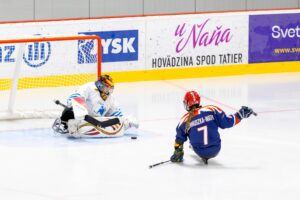
Q: Why para ice-hockey?
A: The moment I saw it my eyes lit up. I’d never seen a para sport like it. It’s a really fast paced sport, I think that’s why I love it compared to other para sports. I’m out of my chair, I’m in a sled. Everyone’s the same in a sled. There’s a moment you get on the ice and there is that moment of freedom. And to have that not in my chair is personally what I love. To be able to move and be free. There’s being free in your chair but to experience that freedom on the ice is like a drug for me – petrifying and exhilarating. And to do that for your country is another level – there is a moment where you catch yourself in a GB jersey and it brings out the fire and passion even more. If I said it was easy I’d be lying, there are times when I’m in tears to the ice rink but then you see me ten minutes into playing and I’m a different person.
Q: Did you always want to get back into sport after your injury?
A: I was initially very against sport, it was never part of my plan, but I had a beautiful sports coordinator at Stoke Mandeville, her name was Liv Davidson. She never forced me but would coax me; “it’s sports afternoon today” and I would sulk but one day I got in a sports chair. She coached me and got me back into sport. Sport felt like free rehab.
Q: When you were playing rugby pre-injury the profile of both women’s sport and para sports was lower than it is now. How does it feel to see that rising?
A: It definitely was. Loads of people have carved the pathway for women’s sport. I was part of the generation that carved a pathway for women’s football and the women’s rugby world cup has recently been played and it’s everywhere. Everyone knows the players names and the stadiums are full. For us at the women’s world championships, every game we played, the rink was full. People are being exposed to women’s sport more and celebrating it more. It’s beautiful.
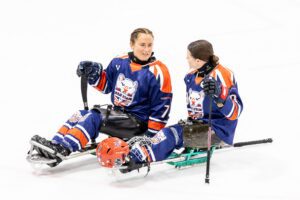
Q: Does the pain you live with every hinder the training you have to do?
A: It does. I’ve been seeing a neuropsychologist for over a year now because living post-injury I have suffered with depression and anxiety, and I was diagnosed with PTSD that would just appear out of nowhere. In my first ever international competition I just had a massive panic attack, which surprised me. But this is why I love sport, it heals you. I would have gone through life and never addressed those things if I wasn’t in sport. I’ve come to terms with the fact that there are things I can’t control and pain is one of them for me. I have a very set training regime but I have a plan A day and a plan B day. A plan A day would be if I get up feeling well, not too much pain and I can do all the training I’d planned. But if I wake up and the day is bad, I can move to my plan B day where I can’t train but maybe I can still watch a match of hockey and take notes so I’m still working towards my goals. It helps me accept there are things I can’t control but I can still work around them. I’ve found a level of resilience that means I can push through and still have a life with the pain. And it is difficult, but I value the life I get from having that mindset.
Q: Where did that resilience come from?
A: I think always being in sport. I asked for my first pair of football boots when I was three years old and I played with boys so I was taught resilience then because no one would pass to me because I was a girl. So my mindset was that I was going to prove myself to make you pass to me. So, from a young age I learnt resilience in sport – I was always on the back foot, I was a girl in a men’s team or I was 5 foot 3 and people lined up against you and thought it was going to be an easy game. I show them don’t judge the player in front of you because you never know.
Q: How do you combine being a mum with the intensity of the training you have to do?
A: My daughter was just seven weeks old when I flew out to the US for the first world challenge. To overcome lots of battles through the pregnancy and then still make it was so hard, I was pumping milk while the coach was giving team talks. When you look back at the whole journey it’s been a wild four years. I very much live day by day and I try not to be too hard on myself for the things I can’t achieve. After eight years I feel like my wings have been unclipped. I’m so supported at home, my husband does a lot as there are some times when I’ve been in bed for three days straight. But there are things I am really good at, I give great emotional advice, I give great cuddles. My children are my role models, they are the reason I’m here and thriving and the reason I do my best. I want them to see that when life gives you a bad hand you haven’t lost.
If you or someone you know is interested in para ice hockey contact the British Para Ice Hockey Association
Photo credits © Ian Offers (GB Para Ice Hockey)
 This article was featured in the Winter 2025 issue of FORWARD, the only magazine dedicated to the spinal cord injury community.
SUBSCRIBE TODAY