Blog
Turning adversity into opportunity - Melanie Reid (Forward - Winter 2025)
SIA columnist Ruth Hunt discusses mental health with award-winning journalist and author Melanie Reid MBE.
In 2010 journalist Melanie Reid MBE sustained a serious spinal cord injury (SCI) following a catastrophic fall from her horse. Since that time, she’s done so much to change the conversation about disabilities and SCI through her weekly (The) Spinal Column in The Times Saturday magazine.

After such a serious injury Reid was unsure whether she’d ever be able to work again. In her memoir, The World I Fell Out Of, she describes having a journalistic ‘epiphany’ while in a high-tech scanner, realising: “I’ve got to tell people about this.”
Unable to use her hands at the time, she had her son place a Dictaphone on her pillow so in real-time she could tell her readers what was going on. Realising the potential in this material, Reid’s editor asked if she could produce a weekly column for The Times magazine, later called: ‘The Spinal Column’.
This column was published weekly, only ending recently. I asked Reid how she managed to turn such adversity into something that had purpose, gave her employment and independence and in turn helped others with SCI.

The Spinal Column had multiple benefits. It let readers know what was happening after your accident, and in doing so, opened-up a long-running conversation about disability and care. But it also had benefits for you?
“Initially it was a way of trying to make sense of what was happening. To marvel at the weirdness of it all, to express and expel grief. To hit ‘send’ and feel rid of a bit of the hurt and the feeling of uselessness.”
“Working gave me empowerment and self-worth. It also stopped me going mad with boredom. It was something I could do by myself – I didn’t need to ask for anyone’s help. Earning a salary also meant I could afford to buy equipment that gave me more independence.”
As everyone with a SCI knows, even with independence, physical problems can be difficult for anyone to overcome. How did writing this column help with these challenges?
“It gave me a feeling of security and self-worth. It was a way of dealing with horrible things and embarrassing disasters because I’d say to myself, well, at least I’ve got something to write about, here’s something I can turn into a blackly funny column. Laughter helped. And being relentlessly positive has become a bit of a game, a discipline I have learnt to follow.”
The Spinal Column has now come to an end – are you still managing to write?
“I’m past retirement age but I need to work. I’ve got a fortnightly column with the Observer, about caring issues. The Times will also give me occasional freelance work. My husband has Alzheimer’s and I’m his primary carer, throughout the day and night. It can be grim, so writing is my escape. Along with that, I’m still kidding myself I can write another book – but about something completely escapist!”
Like you, I’m getting older with SCI and at times, I find it hard to be resilient. How are you managing physically and emotionally?
“Getting older with SCI is hard because everything gets more difficult, and I feel a lot more pain. I’m scared I might, at some point, lose my independence. If I make it to 70, I’ll be thrilled.

We’re coming into winter. What do you like about the season?
“I’m going to enjoy this winter because this year, it won’t be a fight to keep warm. We’ve been lucky enough to build an accessible extension in our garden and this spring we moved in, leaving behind the cold, cramped and ramped cottage I’d struggled in for years.
“It’s like moving from the 17th century to the 21st. Underfloor heating! A flat floor! Wide doorways! Bliss! No more struggle. Believe me, I appreciate how fortunate I am compared to many. (Though in common with most SCI, my feet are still like blocks of ice when I go to bed, despite the steady 21-degree heat. Some things you can’t win.)
As we come to the turn of the year, it’s often a time for reflection. Many people with SCI think about how they can turn their journey into material for books, articles, vlogs or podcasts. What advice do you have for keeping topics relevant, fresh and interesting?
Get chatting as soon as possible in your journey. Be frank. Make it as funny as possible. Talk about the untalkable and discuss the undiscussable.
Talk to famous or well-known ‘paras’ and ‘tetras’. And non-disabled people who have important things to say too. Why not also talk to SCI contemporaries who are funny or doing ambitious things. Also do challenging stuff, looking into difficult subjects – such as assisted dying.”
You mentioned being ‘relentlessly positive’ – how can those of us with SCI apply that mindset in our lives?
“Keep yourself busy looking forward and planning, so you don’t have time to dwell on stuff too much. And when life is bad, think about those worse off than you, and those who love you. Grit your teeth and keep smiling. That’s what I did and still do.”
Signing off with seasonal greetings and best wishes for 2026, Ruth.
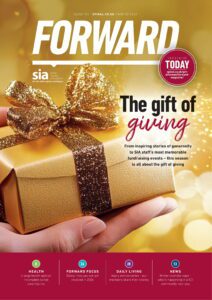 This article was featured in the Winter 2025 issue of FORWARD, the only magazine dedicated to the spinal cord injury community.
SUBSCRIBE TODAY
 Melanie Reid’s Sunday Times bestselling memoir The World I Fell Out Of’ provided the background to many of her columns and is available here: amazon.co.uk/World-I-Fell-Out/dp/0008291373