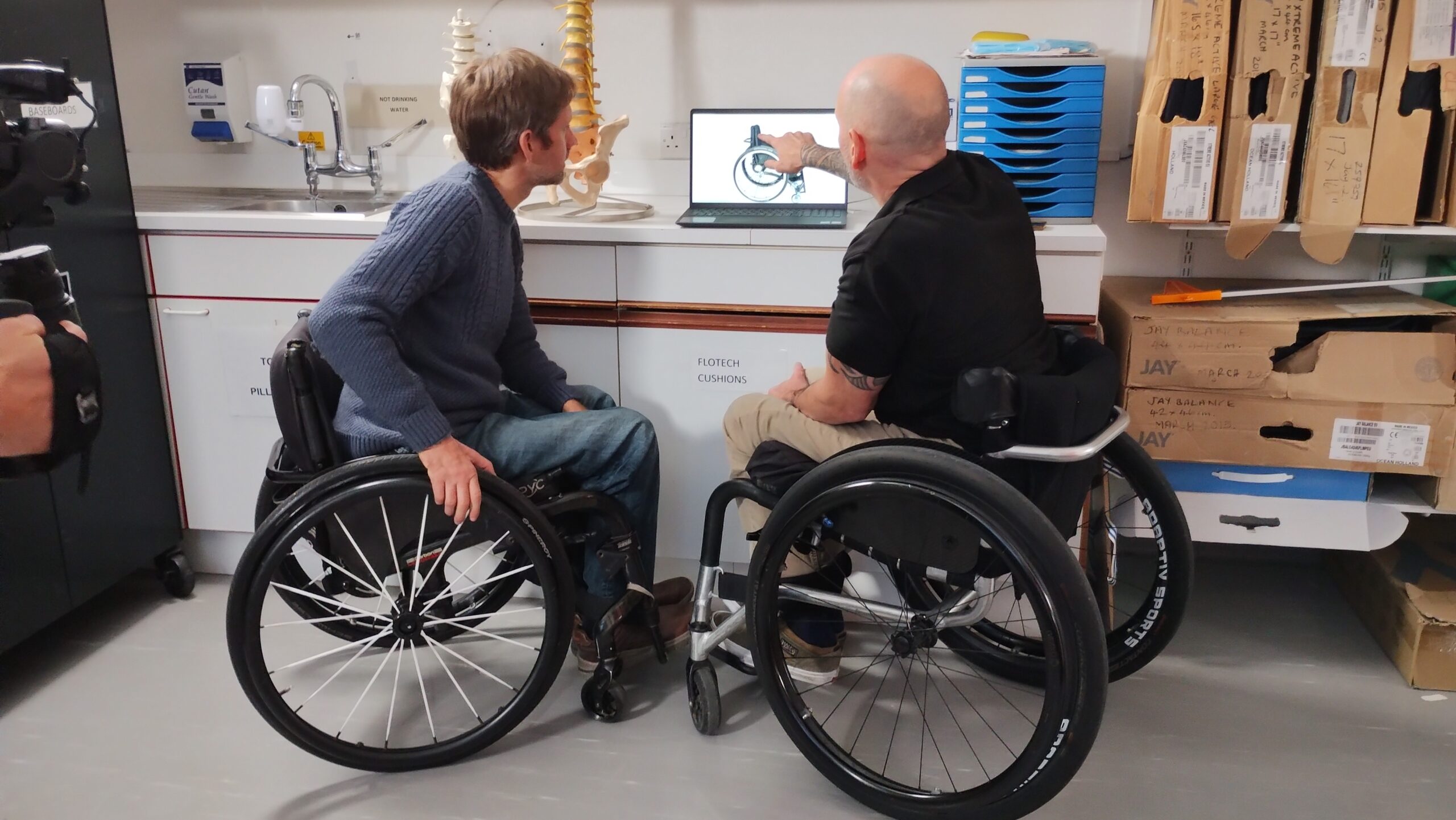
This guidance aims to give you some information about your posture, how best to look after it and how it can be affected when you have a spinal cord injury.
The following information should help you check your posture, know when you might have a problem and when you need to contact a health professional for more advice and support.
What does posture mean?
Posture is the way you hold yourself or position your body when you’re standing up or sitting down. Positioning your body can be deliberate or happen without you even realising.
What does good posture look like?
• Head – aligned, not dropped forward or tilted to one side.
• Shoulders – level and relaxed, not rounded or hunched.
• Back/Spine – supported and upright, avoiding leaning or collapsing to one side.
• Pelvis – level, sitting evenly on both sitting bones.
• Legs – supported, hips and knees bent comfortably at a 90° or right angle, feet flat or supported.

Why might it be difficult to manage your posture after SCI?
The neurological damage that happens after a spinal cord injury can cause some or all of the following:
- Reduced movement or no active movement.
- The left and right sides of the body having different muscle strength / asymmetry.
- Uncontrolled or involuntary movements (spasms/increased tone).
- Changes in sensation or awareness of where your body is.
All of the above can increase the chance of a poor posture developing over time … but there are lots of ways you can reduce the risk of poor posture through support and correction.
How can you maintain good posture and prevent postural problems?
- Change your position regularly, whether you’re in bed or sat in your wheelchair.
Avoid being in one position for any length of time, especially twisted or awkward postures, whether you are lying or sitting (in bed or in a wheelchair).
- Know how to check and correct your posture, ideally using a mirror, throughout the day. If you can’t do this yourself, then you need to know how to instruct someone to help you with it and feel comfortable asking them to do it.
- Make sure you’re using the right cushion and wheelchair for your needs. Remember, if your circumstances change, you may need a review of your wheelchair or cushion.
- Find out more about this from our getting a wheelchair, wheelchair cushion and cushion maintenance information sheets.
INFORMATION SHEETS
Get help from a medical professional, such as a physiotherapist or occupational therapist, if you need to; for example, if you’re unsure whether your cushion is right for you or you need support with checking and correcting your posture.
Other things that can be helpful for your posture include the following:
- supportive backrest (one which allows you to adjust the support)
- chest strap (to keep you in a good position)
- orthoses (such as a fabric corset)
- adjustments to your wheelchair, such as changing the amount of recline or tilt.
- cushion adjustments/alterations.
- lateral (side) support pieces to support your body position.
- a personalised programme of stretches put together by a healthcare professional.
What to do if you develop postural problems?
It’s always better to prevent postural problems if you can.
If you’re worried about your posture, or concerned that problems are developing, contact a healthcare professional (such as your GP, physiotherapist, occupational therapist or wheelchair service) as soon as possible to get advice, an assessment, and equipment if necessary.
It’s important to determine whether the postural problems you have are ‘fixed’ or ‘flexible’.
If the posture is flexible, then the skeleton can still be moved, and the problem can be reversed. Equipment can be used to correct your position. If the posture is fixed, then the skeleton does not move out of this position and is ‘stuck’. Equipment can be used to support your posture and prevent it from getting worse.