Mindset and resilience

Mindset and resilience

This sheet has been written by one of SIA’s peer counsellors, who has lived experience of spinal cord injury.  


When we think about travel, these are some words that could come to mind: fun, adventure, joy… but also, potentially, fear and anxiety. A word less likely to come to mind might be resilience.  

Resilience – best defined as ‘the capacity to withstand or recover quickly from difficulty, or toughness’ – is a vital coping mechanism for people with spinal cord injury, especially during travel. When we travel, so many obstacles can come up for us. Whether it’s a trip to Tesco or a holiday to Australia, travelling with a spinal cord injury is challenging to say the least. But when we have resilience to help us bounce back from any problems that occur, it means that travelling not only becomes an option, but also something that offers us great excitement and happiness. 


Leaving the house – preparation 

To build resilience, preparation can be a good place to start. If we want to withstand or recover quickly from any difficulties that may occur, preparation gives us the chance to think through the types of challenges we might meet on our travels. When I’m preparing to leave the house, I like to make a list of everything I might need to know about my journey and my destination. Some things that often appear on my lists include: 

  • Accessibility at the place I’m going to – are there lifts or ramps, if the building does not have level access? Do I need to give prior notice, etc? 
  • Is there Blue Badge parking nearby? 
  • Does the venue or location have disabled toilets? 
  • Will I need to take somebody with me, or is this somewhere that I can manage independently?  

By preparing and troubleshooting for some of my known basic needs, I can ease my anxiety and allow myself to feel more in control. This helps me trust that my basic needs can be met, without needing to rely on any resilience. So, when difficulties do occur, I will still have the scope to be able to cope.  


It’s also very normal and completely validated to feel anxious and perhaps a little fearful when it comes to travel, whether it’s a small trip out, or a big trip. Anything that takes us outside of what feels normal often brings up feelings of anxiety and fear. Although it’s normal and important to feel those emotions, it’s also important to make sure they don’t solely dictate and control the behaviour which then follows.  


During travel  

Once we’ve completed our preparation, we’re ready to leave the house. Remember, it’s completely normal at the beginning of travel to feel some anxiety and fear, as well as feeling excitement and a sense of adventure. Hopefully, our travel will be smooth sailing, and everything will go to plan. However, travelling with a spinal cord injury can bring up unexpected challenges. Even when you do all the preparation possible, challenges can occur when you least expect them. Some of these challenges can include denial of travel, lifts being out of order, no drop kerbs, difficult terrain, or disabled toilets being out of order. The list is endless! This is where we need to be able to rely on our resilience to get us through. When we’re met with these challenges, our instant reaction can be to panic and allow our anxiety to take over. In those moments, this can lead us to react in different ways; we may become very angry or sad, we may even decide to completely abandon our travel plans and go home, feeling deflated and promising ourselves that we’ll never try that again. However, we do have different choices around how we can react.  
Choice points


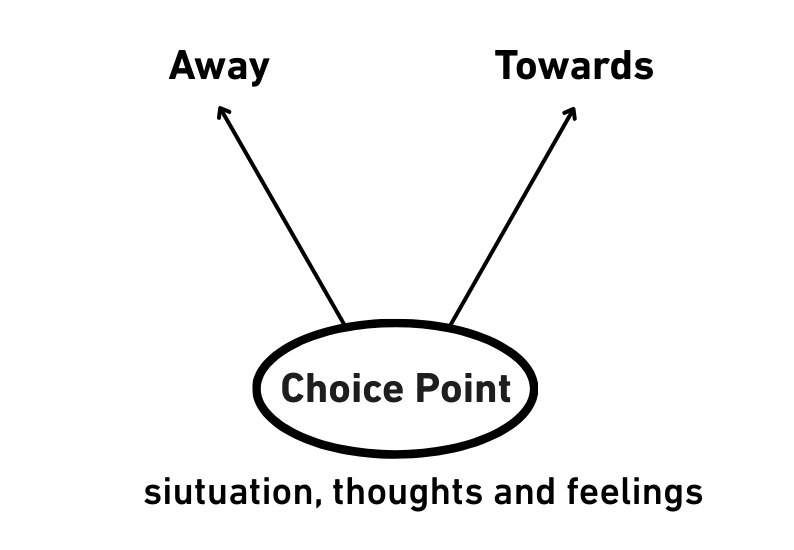
Choice points are a well-established reflective coping mechanism used in Acceptance and Commitment Therapy and created by the therapist, Dr Russ Harris. They work by helping us reflect on our behaviour, enabling us to make different choices moving forward. When a situation occurs, this can spark a thought or a feeling. Here’s an example: 


how to choose a fulfilling life

media image

I arrive at my local train station and discover that the lift is broken. I immediately feel disappointment and anger. I’m unable to walk up the stairs to access the platform. It feels unfair that my needs aren’t being met; and now I can’t access a facility that I need. This is my ‘choice point’. I have two options as to how I could proceed.  


I could be guided by that disappointment and anger to shout at the staff at the train station and then leave to go straight home. In this instance, my behaviour has been dictated by the anger and disappointment that I felt, and ultimately, I’ve missed out as I’ve decided to go home. I’ve moved away from my goal of travelling on the train to go and do something fun.  


Alternatively, I can notice that I feel disappointment and anger, but trust that my resilience can find a way around this challenge. It’s okay to feel that anger and disappointment; it’s completely normal and validated because it’s not okay that the lift is out of order. But, because I trust that my resilience will kick in, I can choose not to be guided solely by that anger and disappointment. I could decide to express my disappointment in a respectful way to the train station staff and see if we could work together to find a different way for me to access the train. Finding an adaptation that could work for me would still allow me to move towards my goal of getting on the train and heading off to do something fun.  


This adaptation could be asking for some help; could someone help me up the steps safely and carry my luggage? Could a staff member check the next station is accessible (and with a fully working lift) and book me a taxi to said station?  


Whatever adaptation we find, the concept of the choice point is to remind us that we have choices about the way we react in certain situations. And it’s resilience that helps play a vital part in us being able to recover from an unforeseen challenge like this.  


Energy conservation 

Using the coping mechanisms of resilience and choice points can help us find our most effective ways to deal with the challenges that can arise during travel. It’s important to remember that it’s hard to live with a spinal cord injury, and it can constantly feel like we are battling to do even the simplest of tasks. Therefore, being kind and compassionate to ourselves in these moments is essential. One of the ways we can be kind to ourselves while we’re travelling is by accepting more help. Travelling is exhausting with a spinal cord injury; if we can conserve more energy by asking for and accepting help where possible, we can do more and go further at less of an energy cost to ourselves. Having some help can mean that we get to do more and get closer to our goals.  


Post travel  

Once our travels have been completed, it can be very easy to focus on any difficulties or struggles we may have had. But it’s also important that we spend some time focusing on what went right. For example, celebrating our achievements and the fact we successfully pushed ourselves to do something outside our comfort zone. By allowing ourselves to reflect on the choices we’ve made and the fun we’ve had, we build our confidence and motivation to believe that we can do these things again – and this is resilience! 

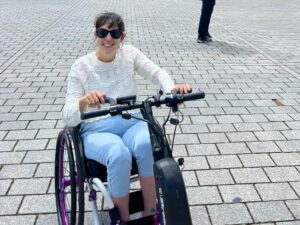
lou-tempest-berlin holiday photo using attachment on front of wheelchair

Download the information sheet

Related resources

Access All Areas Podcast (Episode 2 – Mental preparation)
podcast icon

Access All Areas Podcast (Episode 2 – Mental preparation)

In this episode we will be exploring the idea of emotional preparedness and building resilience for travel. Read More...