Train travel can be a great way to travel locally, regionally, and internationally.
The ability to enjoy all forms of travel is important for the wellbeing of all people with spinal cord injury/CES.As a convenient alternative to car and bus travel, train travel allows you to be independent and return to work and leisure activities. However, it is important to plan ahead to prepare for your trip.Whilst there may be unexpected issues that come up, we hope the following information will help you get ready for your journey.
This page covers basic details about booking, managing your equipment and your personal care needs during train travel for more detailed information download our Train Travel information sheet.
Preparation and planning
For travellers that plan to use a manual wheelchair for most of the time,
planning ahead will help make your journey accessible. Think about:
Wheelchair Skills: Know your limits—how far you can travel before tiring, and how well you manage different surfaces and gradients.
Your Needs: Think about your mobility, care, and assistance requirements.
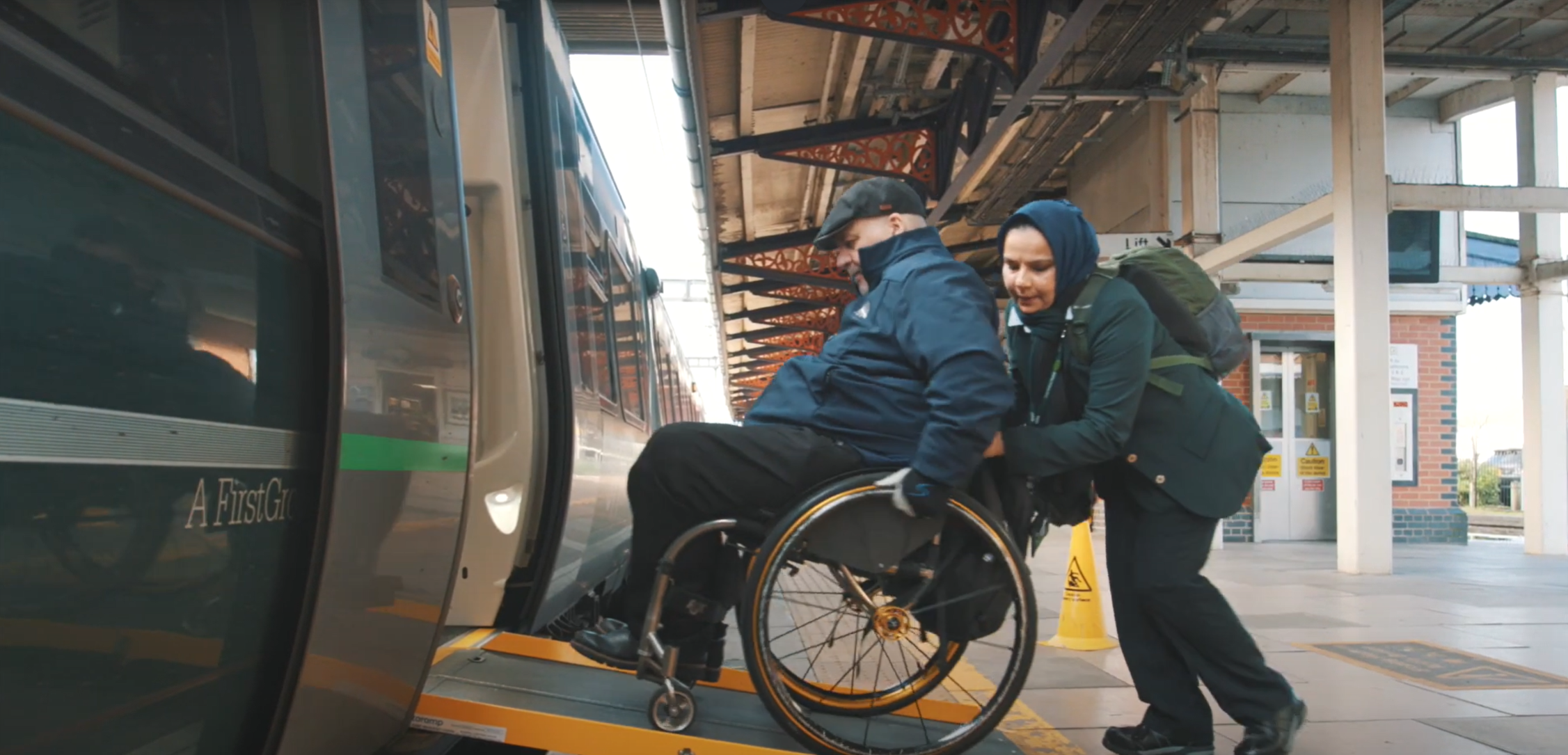
Ramp Use: Station staff can provide ramps for boarding. Always check their placement and ask for help if needed. Some ramps may be steep; descending in reverse can be safer if you’re confident doing so.
Advanced Users: If you have advanced wheelchair skills, you may not need a ramp.
Onboard access: Plan how you’ll reach ticket machines and toilets.
Door-to-door planning: Think about the full journey, including station access and transfers.
Look for Accessibility Info: Search for terms like “step-free access to train,” “platform,” or “from street.
Station Arrival: Plan your arrival time and check parking options if needed.
Wheelchair Spaces: Trains have designated wheelchair areas. Look for signage on platforms and train doors.
Dimensions and Weight: Know your wheelchair’s size and combined weight (with you in it). The standard maximum is 700mm wide × 1200mm long, and 300kg. Some older trains may only accommodate wheelchairs up to 550mm wide.
Your personal and care needs during travel
Planning for your personal health and care needs is essential to ensure a safe and comfortable journey—especially for longer trips or those involving multiple connections. Consider the following:
Find out where the toilets are onboard the train and in the station and take a toilet access key/RADAR key with you.
Maintain your regular pressure relief routines to prevent pressure ulcers. More about these routines can be found in our information sheet, Pressure ulcers: the basics
Allow for rest periods to manage tiredness throughout the day.
Communicate needs clearly to staff for assistance.
Prepare essential documents and medication for the journey.
Photo credit Charlie Budd
Passenger assistance services overview
Passenger assistance services provide crucial support for disabled travelers during their train journeys.
Assistance can be booked online, via app, or by phone, ideally at least 2 hours before travel. Passenger Assist allows you to request an assistance booking in advance either on line or phone
Travelers can also request help upon arrival at the station.
It is recommended to book assistance alongside ticket purchases for convenience.
Staff are available to help with boarding and disembarking from trains.
Any train company can also organise assistance for your entire journey, even if you are travelling on multiple services. You tell them where you want to travel and your needs are. They can help book your assistance and tickets (tickets only if by phone)
You can also visit a Ticket Office to buy your ticket and book assistance – If possible, go to a staffed station ticket office, where they can do this in one step. You can do this on the day or in advance.
Rights and Problem-Solving Strategies
It is frustrating and highly inconvenient when things don’t work. When there’s no ramp, or a lift is out of order, it can make you feel angry and stressed and it can ruin your day. Understanding rights and having strategies in place can help manage unexpected travel issues.
Our Train travel information sheet contains a list of helpful practical and coping strategies. Click on the link below to download a copy.
Various resources are available to assist disabled travelers in planning their journeys. For a more comprehensive list download our information sheet by clicking the link below.
In this video we join our SIA members Simon and Jan as they travel via train from Berkshire to meet their friend Lady-Marie for lunch at Paddington Station in London. Read More...
Using the underground with a disability is possible and we would encourage members to try it. However, there are a number of important points to consider when you have spinal cord injury (SCI) or cauda. Read More...
Bus and coach travel are a convenient alternative to car and train travel, allowing you to be independent and return to work and leisure activities as a manual wheelchair user. Read More...