Blog
Behind the scenes at Coronation Street (Spring 2026 - Forward)
When one of the country’s favourite soaps, Coronation Street, decided to run a storyline about a spinal cord injury, they turned to us, SIA, for advice on how to get it right. Here we interview Hannah Lee, the show’s researcher, for a behind the scenes look at the process and we talk to SIA’s vice president Martin Hibbert and Carol Adcock, our SCI specialist nurse who advised the makers of the show
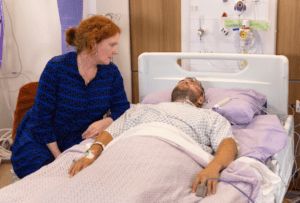

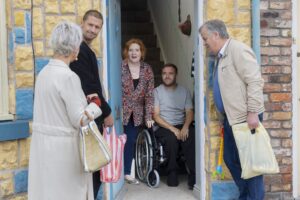
Can you talk me through the initial procedure when you know you’re going to be running a storyline like this? How do you go about getting the storyline right?
We work with the writers and producer, who has the final say on storylines, about 6 months in advance. The story with Tyrone grew arms and legs. Initially he wasn’t going to get a spinal cord injury specifically but when we started researching what might have been the impact of the road traffic accident the idea of an SCI came out of there. It ended up turning into a storyline where we wanted to raise awareness of SCI but initially that wasn’t the idea we went in with. The storyline grew as we researched more into it.
How important was it for you to get the advice you got from SIA and how much did it influence what happened in the story?
With medical storylines we do try to stick to advice a lot to try and be more realistic just because we know how much it affects real people’s lives and our audience will have real-life experience of. Of course, it’s not always possible due to our time frames – we need to speed stories up so that we can play the storylines over the number of weeks we have allocated to cover it.
I know SIA’s Carol Adcock advised a great deal with the process – how crucial was that for you?
Carol was really wonderful – she really helped us initially with the the development of what was going to be wrong with Tyrone after the car crash and then the healing process after that. She helped us develop the storyline and then more specifically with details about physiotherapists and different things people were saying in hospitals and what the prognosis for Tyrone was and what doctors were likely to be saying to him. She was really helpful with the overall picture but also with those key details being right as well. It’s so helpful to have advisors who are so willing to help us like that – Carol, Martin, SIA in general have been so helpful.
How difficult is it to balance the making of a light entertainment TV show and getting the details right about serious health conditions like SCI?
It’s difficult especially with things like SCI, cancer, dementia etc – people have direct experience of these things and we’re talking about things that are happening in their lives so it’s really important we get as much right as we can in the limited time we have. We are a TV show with only half hour episodes so there is only so much we can cover but if we can raise awareness of these issues as best we can then that’s great.
Was it a difficult decision to have Tyrone walk again when realistically he probably wouldn’t have, certainly not in the timeframe you had?
We of course attempt to play it as realistically as possible, but it wasn’t going to work for that actor to never walk again. We have characters general stories mapped out sometimes a long way in advance and for Tyrone, we couldn’t have him in a wheelchair forever. Also, if we were going to have a character as a permanent wheelchair user, we would want to have an actor who was a genuine wheelchair user. Our main objective in the end was to raise awareness of spinal cord injury, not just the physical aspects but the way it impacts relationships with partners, children and everyone else in people’s lives, and we hope we’ve done that.
Martin Hibbert – SIA vice president
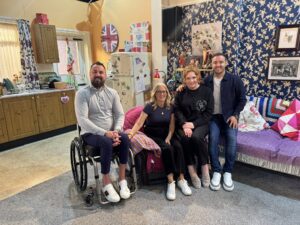
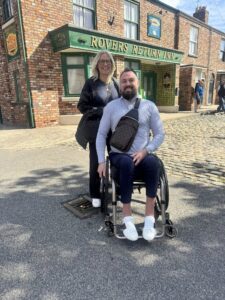
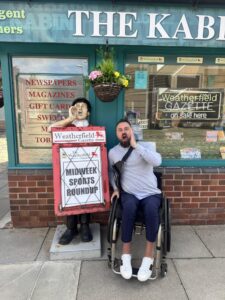
Martin had the great privilege of talking to, and advising, the actors who play Tyrone Dobbs and Fiz Brown – the actors playing the main characters in the Coronation Street SCI storyline.
“I think a lot about representation – not just in politics or policy, but in the everyday places where people form their beliefs. And few platforms in this country shape attitudes more than Coronation Street.
In 2025, I had the privilege of visiting the cobbles as they prepared for Tyrone’s spinal cord injury storyline. It meant more to me than I expected. Because when a show with that kind of reach chooses to highlight spinal cord injury, it’s not simply telling a dramatic story – it’s opening millions of eyes to the reality that so many families live with every single day.
What impressed me most wasn’t just the focus on the injury itself, but the willingness to explore everything that comes after: the strain on relationships, the impact on marriages, the emotional rollercoaster, the identity shift, the grief, the hope, the rebuilding.
These are the parts that are rarely shown, yet they’re the pieces that truly reflect life with SCI.
And when the public sees it – properly sees it – it changes perceptions. It challenges assumptions. It creates empathy. It starts conversations that we desperately need. Here’s to visibility, truth, and progress.”
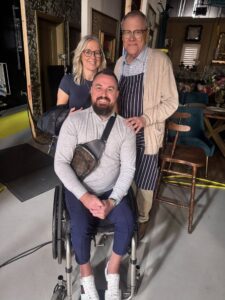
Carol Adcock – SIA SCI Specialist nurse lead
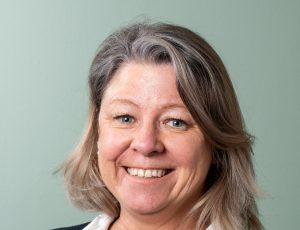 When Carol first started talking to ITV, she was asked to give advice to the writing team to make the storyline as realistic as possible.
“Our SIA communications team linked me into one of the Coronation Street storyboard writers initially. All I knew at that point was that they were going to have one of their characters be involved in a road traffic collision and they were going to sustain a spinal cord injury and could they ask some questions.
The real hurdle was that they wanted the character to recover and as we know that isn’t the case for so many people with SCI. So I was really trying to give advice around establishing at what level the injury would have to have occurred so that it was most probable they could have the recovery they were looking for. They wanted the injury to be at a much higher level initially, but I advised them to come lower down if the character was to walk again later in the series.
After that initial process to establish the basics, I was then linked into the scriptwriters and I started getting sent scripts to check to make sure the information was correct – would a doctor say that for example.
Once scripts were firm, I was then put in touch with the set designers to check details about sets. What kind of wheelchair the character would be in for example – they wanted the character to get in and out of the car from the wheelchair but the kind of wheelchair they initially had in mind would never have fitted in a car so it was advising on details like that so that it was as realistic as possible.
As it went on it got more intense – they would send me questions about details or about the script as they were filming, and they needed replies straight away so it was definitely an intense process. I guess in an ideal world they would have had someone in a consultancy role there on set while they were filming but I had to try and fit it around my day job of course.
In terms of the character recovering, I did advise that if he absolutely had to then maybe he could still have ongoing issues with bowel and bladder, or sexual function issues. I’m not sure if any of that made it in – I didn’t see any reference to it in the scripts. It was all very much centred around not being able to walk. But I understand that it’s a light family show so it’s hard for them to go into full detail. And they work to such quick deadlines – they need storylines to last a certain number of weeks or months and they needed this character to be walking again by December so there was a lot of things that I would have liked to have seen that couldn’t go in. I was advising knowing it wasn’t going to be true to life, but they wanted to make sure the bits they were covering were as close to accurate as possible – balancing light entertainment with the reality of an SCI.
I guess there is always that fear that you can advise on all the right things, but the final show may still have inaccuracies in it – we had no control over any final decisions. I was conscious of not wanting our members, people who live with SCI, to be upset if the show’s details weren’t 100% accurate, but all we could do was advise as best we could.
It was a fun process – I don’t watch the show but some of my family do and they thought it was just amazing. I was invited to go on set but I was on holiday unfortunately so I didn’t make it. Our vice president Martin went to set and in hindsight it was probably more impactful to have him, a wheelchair user, there anyway.
I’m happy we tried to get it as realistic as possible and I’m happy that we’ve helped raise awareness on a national level. If you raise awareness, you raise understanding and if you raise understanding that’s when change is most likely to happen.”
 This article was featured in the Spring 2026 issue of FORWARD, the only magazine dedicated to the spinal cord injury community.
SUBSCRIBE TODAY