Blog
Diving through barriers (Summer 2026 - Forward)
Taking on the notorious Bells Blue Hole diving site in Egypt was about more than just a scuba dive explains Shaun Gash, MBE, 55, from Lancaster.
Thirty-five years ago, I was involved in a road traffic accident that left me paralysed from the chest down due to a T5 spinal cord injury and given days to live. Against those odds, I survived. Life continued, though in very different ways. Learning to adapt to life as a paraplegic – and later as an amputee – were some of the most challenging physical and mental battles imaginable. Yet they also shaped a resilience and determination that define how I now approach life. Each year brings me new goals and challenges, which ultimately led me to scuba diving the infamous Bells Blue Hole site in Dahab, Egypt alongside my friend, blind diver Salim Patel and my diving instructor Curly.

We’d planned the Bells Blue Hole dive for September 2025. We weren’t new to diving having taken on challenges together over the years. Prior to this most challenging dive yet, we’d spent eight days in the Red Sea doing training dives, refining procedures, and building cohesion within the team, but also allowing space to rest and recover.
Traditional diving styles teach you to kick with your legs to propel through the water. Being paralysed means I use my hands and arms to do this. This was definitely challenging at first and it took some time to find my balance, as well as figuring out what equipment would help me be as independent as possible underwater. Now, the feeling of pure weightlessness and freedom to move my body without my wheelchair is something I am grateful for with every dive I do.
To make the experience as enjoyable as possible, we must have the right safety procedures and support in place. So, Salim and I each have one assigned classified buddy under the water, as well as a huge support team of both divers and non-divers who help with aspects on land such as entry and exit into and out of the water.
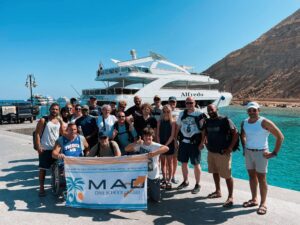
On the morning of the dive there was an atmosphere of anticipation, excitement, and quiet nerves.
Every aspect of the dive was meticulously planned. Logistics covered transportation to the site and entry point itself. There were underwater buddy teams, surface support, and shore-based safety cover. We even had a local medical team in Dahab, ensuring onshore standby support to account for every possible contingency. This level of preparation was essential—not only for safety, but for confidence.
The Bells Blue Hole dive site is renowned in the diving world. Unfortunately, its fame does stem from a series of tragedies which gained it the name ‘diver’s cemetery’. However, the history and culture of the site was so appealing, I felt it could really help illustrate the inclusivity of diving.
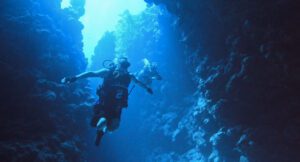
Entering the water at the Bells entrance, we descended through the narrow vertical shaft to approximately 26-metres, passing beneath a small stone arch before reaching our maximum planned depth of 30-metres. From there, we emerged into the vast blue abyss, where the team could finally regroup and settle into formation.
Although it took less than 10 minutes, this part of the dive was a challenge like no other I’d experienced in my diving journey so far. It was exhilarating!
The next stage was the most demanding. Exiting the Bells into open water, we began the long swim of approximately 350-metres towards the saddle point of the Blue Hole. This section required careful management of depth, air consumption, and energy reserves, and currents which, at times were daunting. However, thanks to our training and the extensive planning behind the scenes, we successfully managed these challenges. The dive’s success stands as a testament to preparation, teamwork, and trust. And also something much deeper; the continued breaking down of barriers.
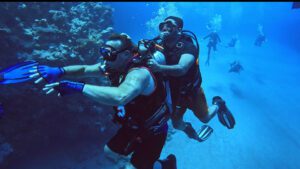
Being underwater is something every diver will describe as freedom. The ability to move your body in ways that are just not possible on land, as well as so many other visual and sound sensations is bliss! In the Red Sea the life underwater is a different world. The colours, animals and structures are phenomenal. The sound of bubbles is almost like meditation underwater and, if you’re relaxed, you can hear the sounds within the coral reefs.
Countless instructors refused to coach me in scuba diving until I met Curly at MAD Dive School in Morecambe in 2019. We had an immediate connection in mindset and ambition. Curly has lots of experience working with adaptive divers and since training both myself and Salim, he’s taught other instructors to assist us and to train other adaptive divers. Through his planning and training, we have achieved many milestones including a 60-minute world-record dive to a maximum depth of 40 metres in 2024.
So, what’s next? My next major challenge has been two years in the making. Later this year, I’ll be kayaking the Komodo Islands alongside three other wheelchair users in support of four charities close to my heart. The expedition will span six days, covering more than 100km through the Indian Ocean, while camping on uninhabited islands within Komodo National Park.
Work continues within my diving journey and in March 2027, alongside MAD Divers, we will host a brand-new adaptive retreat in the Red Sea, designed to encourage wheelchair users and individuals with disabilities to experience the physical and mental benefits of such an adventure-based wellbeing retreat.
- To learn more about Shaun’s sea kayak challenge and to donate visit: givestar.io/gs/rolling-round-the-komodos
- For more information on the MAD Divers School, email: [email protected] or call: 01524 64177
 This article was featured in the Summer 2026 issue of FORWARD, the only magazine dedicated to the spinal cord injury community.
SUBSCRIBE TODAY
Available either in traditional printed format or as a page-turning digital edition
- UK – £24 a year for print magazine, PDF only or PDF plus print
- Europe – £29 a year for print magazine, £24 for PDF only or £29 for print and PDF
- Overseas – £37 a year for print magazine, £24 for PDF only or £37 for print and PDF
We love to hear your ideas for stories and to let us know what you think of the magazine – so do get in touch by emailing [email protected]