Blog
Pressure sores – an Amicapsil update (Forward - Autumn 2026)
In a 2020 Forward article we looked at wound-care product Amicapsil and the incredible results some of our members were experiencing after using it. At the time it wasn’t available on the NHS but has since been adopted onto the NHS supply chain.

Here Karen Briggs, SIA Spinal Cord Injury Nurse Specialist, explores the ongoing realities of getting access to Amicapsil and what more needs to be done to bring it to the people who need it the most
What is Amicapsil?
Amicapsil-SCI is a medical device, developed by Willingsford Healthcare.
It’s a natural wound-care powder, classed as a medical device, developed to help treat complex wounds and pressure ulcers, particularly in people living with a spinal cord injury.
It works by gently drawing bacteria, toxins and excess fluid away from the wound through a process known as capillary action. It uses the body’s own immune system and healthy bacteria to heal the wound.
What are its benefits for people living with SCI?
People living with a spinal cord injury know all too well that skin damage and pressure ulcers are an ever-present risk and are one of the major complications of SCI. Regular skin checks and pressure relief are essential, but even with the best prevention strategies, pressure ulcers can still develop. the costs of which are enormous, impacting on every aspect of a person’s life. They often require long periods of bed rest, increase the risk of secondary complications, decrease the likelihood of being able to engage in community, work, social activities, increase care needs leading to a lower quality of life and reduce independence. So effective treatment is crucial to support healing.
Amicapsil is used by rinsing out a wound and then applying a dry powder. The wound is then gauzed and taped. In 2023 SIA’s Damian Smith and Mark Ridler contributed to a report finding that Amicapsil supports the healing of pressure ulcers 60% faster than traditional antibiotics and antiseptics (the link to that article can be found at the bottom of this article).
Other benefits include:
- No enforced bedrest, allowing the person to remain active
- It is easy to apply to self or by a partner/carer/PA etc and so treatment can be carried out at home.
- It reduces AD and spasms often triggered by wound pain
- It won`t cause antibiotic resistance
Forward magazine had an article on Amicapsil back in 2020 – at the time it was not available on the NHS – why is that?
Getting a product on the NHS supply chain means a product has passed national procurement standards and is available to be purchased. In 2020 Amicapsil was a new class II medical devise and hadn`t made it through the full assessment process. If someone wanted access to it they had to buy it privately as it wasn`t available on the NHS prescription list – or via an Independent Funding Request.
Since that article Amicapsil has become available on the NHS supply chain, does that mean everyone can now get access to it?
It’s not quite that straight forward unfortunately.
Now being available via NHS Supply Chain means that it has undergone another rigorous evaluation of efficacy, safety and economic benefit but even then, despite an item being listed on the NHS supply chain catalogue, nurses often cannot readily access it due to strict local budgets, rationing, and supply chain disruptions. Furthermore, hospitals are not legally mandated to use the national supply chain, and local procurement departments may choose alternative suppliers
Amicapsil has been accepted onto the NHS Supply Chain in England, is approved for use in the UK and listed on the NHS Supply Chain catalogue, but it is not available as a standard, routine prescription at local GP surgeries. This is primarily because it is a Class II Medical Device rather than a traditional medicine, requiring different commissioning processes. Hospitals can access it and provide it to patients if they are still under hospital care. Community availability is more challenging, as neither NHS Supply Chain nor pharmacies are set up for cold‑chain distribution (an uninterrupted, temperature-controlled supply chain used to store, transport, and distribute sensitive pharmaceutical products).
District nurses will now acknowledge that Amicapsil is accepted by the NHS and be willing to support its use but availability in community care is lacking behind.
It sounds like there is still more to be done in terms of getting Amicapsil to the people who need it the most?
Yes, there is still more to be done. We need to raise awareness and help people self-advocate for it. I recently supported a member who had suggested Amicapsil during a conversation with a consultant at a spinal unit. They were prepared to explain the benefits of using it, but it was quickly dismissed before they got the chance.
It’s crucial that SCI Consultants and healthcare professionals are informed about it. SIA has no affiliation to Amicapsil and in no way benefits from them financially, but we have supported research and petitions to try and help people in the SCI healthcare settings understand the benefits of it for the SCI community because we see the results it has for our members. We will continue to support the work on this and help raise awareness of Amicapsil to all. SIA will support its availability on the NHS, so that clinicians supporting those with a SCI and skin issues can make informed choices.
READ THE FULL 2024 STUDYsteve’s story
Find out more about Amicapsil go to www.willingsford.com
More information
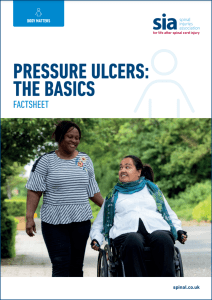
For more information on pressure ulcers, please visit Spinal Injury & Caring For Your Skin and click on the factsheet Pressure Ulcers: The Basics below to download:
 This article was featured in the Autumn 2026 issue of FORWARD, the only magazine dedicated to the spinal cord injury community.
SUBSCRIBE
Available either in traditional printed format or as a page-turning digital edition
- UK – £24 a year for print magazine, PDF only or PDF plus print
- Europe – £29 a year for print magazine, £24 for PDF only or £29 for print and PDF
- Overseas – £37 a year for print magazine, £24 for PDF only or £37 for print and PDF
We love to hear your ideas for stories and to let us know what you think of the magazine – so do get in touch by emailing [email protected]