News
SIA response to free bus pass for disabled people
The Spinal Injuries Association (SIA) has welcomed the Government’s announcement that disabled people in England will be able to use their concessionary bus passes 24 hours a day from April 2027, but has warned that removing restrictions on when disabled people can travel will only make a difference if they can actually get on a bus in the first place.
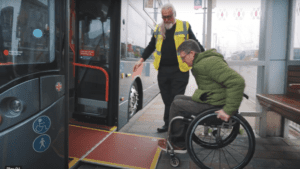
The change will remove the current national weekday restrictions on concessionary bus passes, which generally limit free travel to between 9.30am and 11pm. For disabled people travelling to work, education, medical appointments or simply taking part in everyday life, removing this restriction is a positive step towards greater independence.
However, for many wheelchair users, significant barriers remain. SIA continues to hear from our members who are left at bus stops because the designated wheelchair space is occupied by passengers, luggage or pushchairs and drivers fail to take reasonable steps to make the space available.
For someone with a spinal cord injury who relies on a wheelchair, being unable to board is not simply an inconvenience. It can mean missing a medical appointment, arriving late for work, being unable to meet family and friends or being left waiting without knowing whether the next bus will be any more accessible.
There is also a fundamental question of availability. For disabled people living in rural communities, where bus services may be infrequent, restricted or non-existent, extending the hours in which a bus pass can be used does little to improve their ability to travel independently.
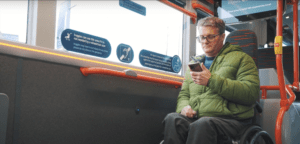
SIA believes the Government’s announcement should therefore be the beginning of a wider conversation about accessible transport networks, rather than the end of one.
Mark Ridler Director of Programmes and Services of the Spinal Injuries Association, said:
“Giving disabled people the freedom to use their bus pass at any time of day is a positive and welcome change. Disabled people work, study, attend appointments, socialise and live their lives at all hours of the day, and our public transport system should recognise that.
“But a free bus pass isn’t much use if the bus driver leaves you at the kerb.
“For wheelchair users, accessibility isn’t just about the design of the bus. It is about what happens when that bus arrives. We still hear from people who cannot board because the wheelchair space is occupied and drivers are unwilling or unable to ensure that the designated space is made available.
“And for somebody living in a rural community where there may only be a handful of buses a day or no suitable service at all, being told they can now travel for free 24 hours a day risks feeling like an empty promise.
We welcome this announcement, but affordability, accessibility and availability have to go hand in hand. The ambition should be simple: when a disabled person wants to make a journey, they should be able to do so with the same confidence and independence as anybody else.
SIA is calling for the Government to use the introduction of 24 hour concessionary travel as an opportunity to strengthen the experience of disabled bus passengers more widely.
This should include ensuring that bus operators and drivers understand and uphold the rights of wheelchair users, improving accountability where wheelchair users are refused access, and ensuring that the needs of disabled people are central to decisions about bus routes and service provision, across the country – in both urban and rural communities.
The Government’s announcement is an important recognition that disabled people should not have their lives restricted by arbitrary travel times. SIA now wants to see that same principle applied to the other barriers that continue to prevent wheelchair users from travelling.