Blog
Boys do dance by Mark Brew (Forward - Autumn 2026)
Marc Brew, SIA’s Champion for Performing Arts, is an award-winning Australian performer, director and choreographer, whose work has been toured to critical acclaim across the world.
After sustaining a spinal cord injury in 1997, Marc returned to dance, exploring movement using his wheelchair and paving the way for other disabled and non-disabled dancers
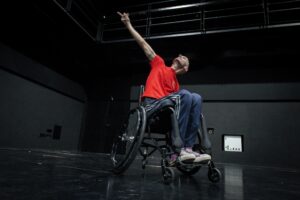
Q What drew you to dance as a young person? Do those same aspects that appealed to you then, still draw you to dance today?
A Growing up in a small village in rural Australia there wasn’t much opportunity for a young boy to dance, it was very much frowned upon. But I always had lots of energy, doing backflips and somersaults, so my mum put me in dance classes. We had a teacher who travelled to different villages in the area – she came on Fridays to the church hall. That’s where she taught us jazz and ballet, which I very much fell in love with. I was really inspired by older movies, such as those with Gene Kelly and Fred Astaire. I just loved watching them be so active and expressive on TV. I also watched a lot of movies in the ’80s, such as Footloose, Dirty Dancing and the TV series Fame, Girls Just Want to Have Fun, and I loved the joy that dance brought. It made me feel comfortable and confident as a young boy. I just wanted to do what they did. That was the dream. Dance still enables me to be who I want to be. I love being on stage and having the confidence to express myself through movement, and to share that with an audience is really rewarding.
Q What was your experience of returning to dance after your spinal cord injury? In what ways did you have to adapt, and did you feel well supported?
A Being a dancer, my body was my instrument. So to be involved in a car crash at the age of 20 was my worst nightmare. At that age, you think you’re invincible and that nothing is going to stop you and then, suddenly, this unexpected life-altering change happens. I just remember the doctor coming in and saying, “I’m sorry, Mr Brew, but you’re never going to walk again.” I was thinking, “No, this can’t be happening to me. I’m Marc, I’m a dancer.” That was part of who I was, it was my identity. I thought, “I’ll do what I need to do, I’ll do the exercises, I’ll improve and I’ll walk again. I’ll continue dancing because dancing is who I am. It’s part of my nature, it’s innate, within me.” I was going to find a way to continue dancing. I guess you could say I was being naïve, but honestly, that’s what I thought was going to happen. Everyone thought my career was over. My family encouraged me to go back to university or college and study something new. But the burning desire to continue dancing and to be a dancer was still within me. What I had to do was change my own perspective about what it meant to be a dancer. I realised that even though I had this formal dance training and this expectation that a dancer should have good turnout, beautiful legs and flexibility, dance is really about being able to express yourself through movement. I could still do that – it was just different. That definitely set me on the course of creating my own work as a choreographer and discovering how restriction, and also my disability, could create new and interesting possibilities for movement.
Q Your work involves advocating for, championing and celebrating difference in the creative industries. What have been the challenges of this work? And what are the achievements you’ve been most proud of?
A I think, for me, the biggest challenge has been people’s attitudes and society’s perceptions of what a person should be and what they should or shouldn’t be doing, especially someone with a disability. After my SCI it was expected that I shouldn’t dance anymore because disabled people don’t dance. The car crash I was involved in happened in 1997, and there just wasn’t much exposure or representation then. I didn’t see anybody else with a disability on TV or on stage dancing – there were no role models for me. In Australia, there was simply a lack of opportunities for me to continue dancing because people didn’t know what to do with me. I ended up moving to New York City and working there with a company called Infinity Dance Theatre. I retrained as a dancer with a disability, using my manual wheelchair, and explored how I could transpose existing dance techniques onto my upper body and move with my chair. Now, as an experienced disabled dancer, it’s really important for me to create opportunities for the next generation of disabled people who want to dance, to be that role model so people know there are possibilities. One of the things I’m really proud of is being able to inspire other disabled people. I’ve dedicated myself to advocating for the idea that difference creates possibilities and that within difference there is also beauty. I love what the lived experience of disability brings to the creative process. It really pushes the boundaries of what dance can be.
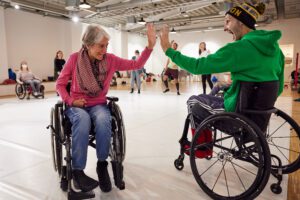
Q How did the Marc Brew Company come to be? Was opening doors for disabled artists always at the heart of the company’s mission?
A I moved to London in 2003 to work with Candoco Dance Company, where I had a wonderful career. I travelled around the world, teaching and performing, and worked with some fantastic choreographers. But for me, as a creative and as a choreographer, I felt I needed more opportunities. So, in 2008, I founded the Marc Brew Company. The mission was to create a company that would be my vehicle for producing the work I wanted to make and for collaborating with a diverse range of artists to make new work that is disability-led. From the very beginning, its mission has always been about embracing diversity and difference, and showcasing that on our main stages through cutting-edge, trailblazing work.
Q What do you hope audiences get from the company’s performances?
A One thing I love about the work we’ve created is that we’ve really explored all elements and areas of work – from outdoor work and site specific performances to work for young audiences. We really try to create work that is versatile and engages with different people. But the main thing I hope audiences get from our work is to be moved and challenged about their own expectations of what dance should be, what dance should look like, who should be dancing and who should be making dance. I want people to have an experience. I want them to feel something, to question thing and to get excited by the work we create.
Q You’ve achieved incredible accolades and recognition for performing and choreography. What does this mean to you personally and what does visibility like this do more broadly for the creative arts?
A I do what I do not for the accolades or the recognition, but because I want to make a difference. I want to create change and create opportunities that weren’t there for me both as a young boy who wanted to dance and later as a disabled person who wanted to dance and was so often told: “No.” Through our work, and through representation and visibility, people can see what’s possible. It shows that we can create change and celebrate the beauty of difference on our stages.
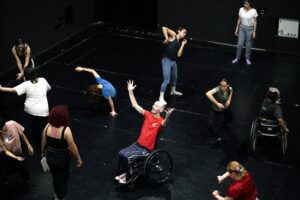
Q You’re now a part of the SIA family and we’re so grateful to have you! In your role as Champion for Performing Arts, what do you hope to bring to our members and to the wider SCI community?
A I can’t believe it’s taken me this long to be a part of the SIA family, but I’m glad that we’ve found each other and I’m really excited to be part of it. Sometimes we can feel quite isolated, and I’ve definitely felt that as a disabled person. So, to be able to have community and build community is really important to me and to my company.
I hope to share our work, what we do, and our mission, vision and values, which I think align very closely with SIA’s. I hope we bring a different perspective to what people’s expectations are around dance and the performing arts, and show that people with spinal injuries, disabilities, neurodiversity, can be part of that world and there are opportunities. It’s about showing what’s possible, and I think there’s no better way to do that than through creativity and the arts.
INTRODUCTION TO MARCMEET OUR sia CHAMPIONS
FURTHER INFORMATION
After a successful Edinburgh Festival Fringe run with Boys Don’t Dance, Marc Brew will be touring his auto-biographical work an Accident / a Life, created in collaboration with Sidi Larbi Cherkaoui, this Autumn. To find out more go to marcbrew.com
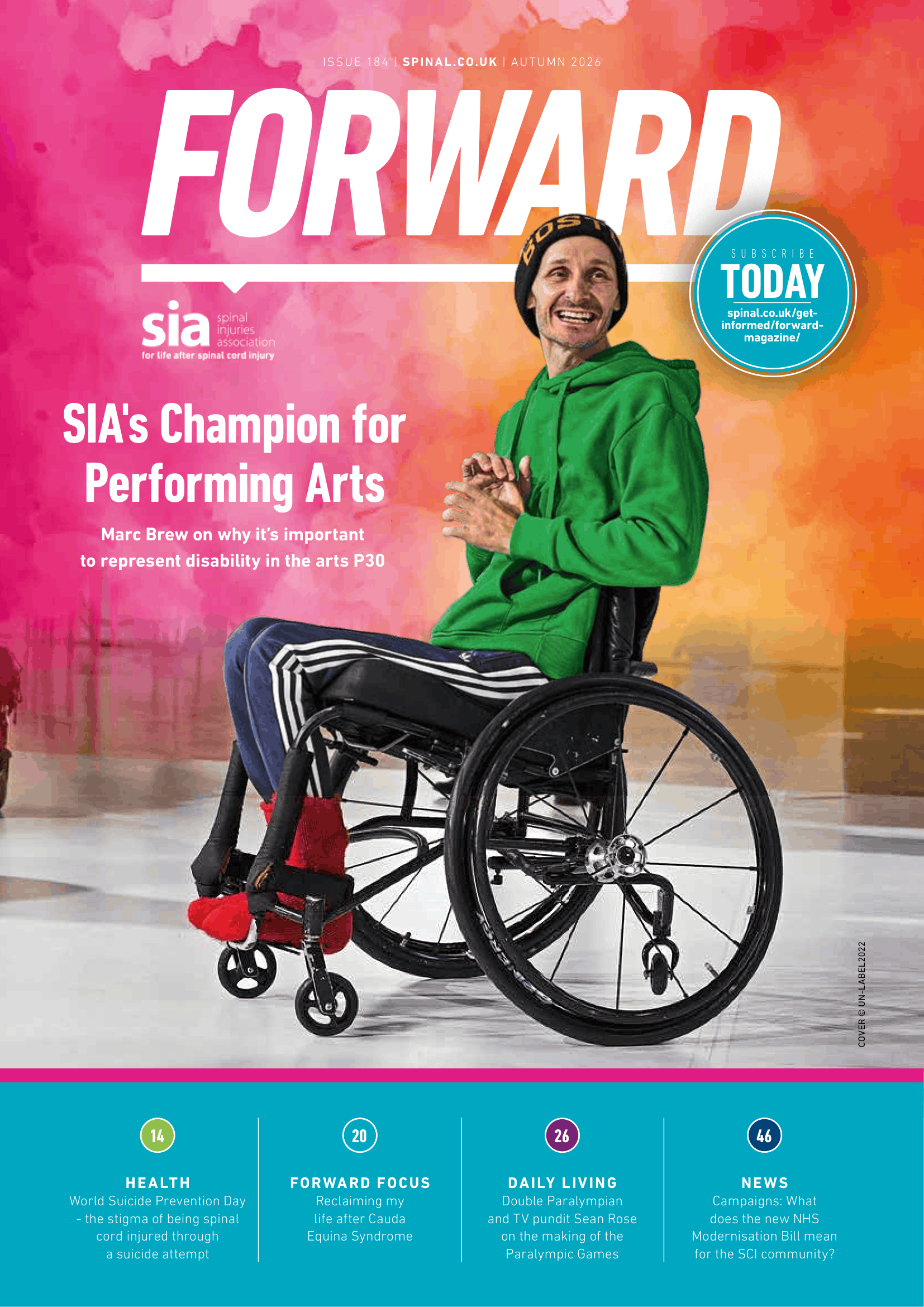 This article was featured in the Autumn 2026 issue of FORWARD, the only magazine dedicated to the spinal cord injury community.
SUBSCRIBE
Available either in traditional printed format or as a page-turning digital edition
- UK – £24 a year for print magazine, PDF only or PDF plus print
- Europe – £29 a year for print magazine, £24 for PDF only or £29 for print and PDF
- Overseas – £37 a year for print magazine, £24 for PDF only or £37 for print and PDF
We love to hear your ideas for stories and to let us know what you think of the magazine – so do get in touch by emailing [email protected]